
85% Less Bone Loss — From a Probiotic Made of Squash and Peppers
Weight health means healthy bones. That means bone building on par or exceeding bone breakdown. Turns out what you eat AND your microbiome are keys. Here's why and how to make it deliciously doable.

I talk a lot about the digestive tract as a muscle — one you have to train, feed, and protect consistently over time. But here’s what most people don’t fully appreciate: your gut muscle isn’t just running your digestion. It’s also running your bones. That’s weight health exemplified.
For the last decade, research has been quietly building a case for something called the gut-bone axis. We’ve always know that your hip bone and thigh bones connect, but now its clear that their health depends on your microbiome. Emerging science and practice evidence is genuinely exciting: the health of your gut lining, the microbial diversity in your intestines, and the metabolites your bacteria produce all directly influence whether your bones rebuild or break down.
My 50 year old patient sent me this the other day. It’s been 2-3 years of consistent adjustments, some Paula Abduhl “two steps forward, one step back” injury and illness (life life-ing) moments, but what a beautiful medication-less win!
I just got my DEXA back and for the first time in 20 years my bone is building - no bone loss! My doctor is thrilled and so am I. Ashley, this gut-bone stuff is real. THANK YOU.
— Lisa, BNP client
This is the kind of connection that changes how we think about bone loss — and it’s exactly why I want to walk you through this emerging area, including a remarkable new clinical finding around a synbiotic medical food called Bōndia.
NOTE: I first explored this food supplement for my patients, and after their outcomes and the research, I said ‘heck yeah’ to helping them spread the word as a paid strategic partner. I will always be upfront about why and what I am doing with any products or brands mentioned in posts here and everywhere I share content.
The Gut-Bone Axis: What It Is and Why It Matters
Your skeleton is not static. Bone is living tissue in a constant state of remodeling which is the fancy word for cell turnover. We have osteoblasts that build new bone, and osteoclasts break old bone down. When the balance tips toward too much breakdown (resorption), you lose bone density. That’s osteopenia first, then osteoporosis.
For decades, the conversation around what drives that imbalance focused almost exclusively on calcium then vitamin D and now more than ever estrogen. Those are all real, but they’re not the full picture. What science has now confirmed is that suboptimal gut microbiome is a powerful upstream driver of bone loss.
Here’s how it works: when your gut microbiome is disrupted, several things happen simultaneously. Gut barrier integrity weakens (what many people call “leaky gut”), allowing inflammatory molecules to pass into the bloodstream. This leakiness also hampers key bone-building nutrients from getting where they are supposed to go AND your weight-health hormones from getting signals and being deployed. Yeah that’s a long sentence, and it should explain A LOT. Inflammation activates immune pathways — specifically, it increases RANKL, a signaling molecule that stimulates osteoclast activity and accelerates bone resorption.1 At the same time, a disrupted microbiome produces fewer short-chain fatty acids (SCFAs), the metabolic byproducts of fiber fermentation that play a direct protective role in bone metabolism.
“Gut microbiota regulates bone metabolism through multiple mechanisms. SCFAs produced from microbial fermentation of dietary fiber beneficially impact bone health by inhibiting osteoclasto formation and through immune modulation.”
— Feng et al., Medicine, August 2024 1
SCFAs — particularly butyrate and propionate — protect bone in several ways: they inhibit osteoclast differentiation, stimulate osteoblast activity, regulate pro-inflammatory T cells, and reduce TNF-α and IL-17 which are key cytokines that drive bone breakdown.2 In other words, a fiber-fed, diverse microbiome is actively manufacturing your bone-protective compounds every single day — or not, if the gut is dysbiotic.
AND they also promote your weight-health hormone function; specifically, these same SCFAs are involved with activation of GLP-1 and GIP.
So When Does Bone Loss Start? 65? 45? 35? …
And here’s what makes this especially urgent: bone loss starts as early as age 35. or does it? That’s what they tell us. It could be true if life was perfect up until then. No antibiotics, oral contraceptives or other medications (see my article on medications and bone health) and if you didn’t drink alcohol, have stress, or diet at all, ever. Yeah so while bone loss may techinically start around 35, for most of us, we didn’t achieve peak bone mass - ever.
That said, we waste a lot of good bone assessment years where early interventions could prevent dramatic losses. Traditional screening doesn’t begin until age 65 — creating a 15 to 20 year window where loss is already happening and virtually nothing is being done about it.3
Meet Bōndia: A Synbiotic Built for the Gut-Bone Axis
In October 2025, on World Osteoporosis Day, Sōlaria Biō launched Bōndia — classified as an FDA-regulated medical food (not a dietary supplement), specifically designed to address bone loss through the gut-bone axis. What sets it apart is that it’s the first clinically proven synbiotic intervention of its kind, built entirely from plant-derived sources.
85% reduction in bone loss at the femoral neck in women with osteopenia, compared to placebo, in a randomized, double-blind, placebo-controlled trial of 286 postmenopausal women published in Osteoporosis International.3
That number — 85% — is not a typo, and it’s not a supplement-label claim. It comes from peer-reviewed clinical research. Let me break down exactly why this formulation works.
The Bōndia Blend: 8 Ingredients, 5 Plant Sources
Bōndia is a synbiotic, meaning it combines both prebiotics (what feeds the good bacteria) and probiotics (the live bacterial and yeast strains themselves). What makes this formulation clinically meaningful is that the strains were specifically selected for the gut-bone axis — not for general gut support.4
Levilactobacillus brevis SBS04254Probiotic · Sourced from squash supports gut integrity and immune balance to help reduce inflammation and promote bone health.
Leuconostoc mesenteroides SBS04255Probiotic · Sourced from squash works synergistically with SBS04254 to strengthen the gut lining and calm inflammatory immune signaling.
Lactiplantibacillus plantarum SBS04260Probiotic · Fermented pepper paste enhances nutrient absorption, calms inflammation, and helps maintain bone strength and resilience.
Pichia kudriavzevii SBS04263Probiotic Yeast · Fermented pepper paste too, this unique yeast probiotic that supports gut barrier function and metabolic activity in the gut-bone signaling network.
The prebiotic side of the formula is equally intentional:
Bōndia’s Prebiotic Pair
Powdered Organic Blueberry — a fiber- and antioxidant-rich prebiotic that feeds beneficial gut bacteria supporting the gut-immune axis linked to bone health.4
Oligofructose (from Chicory Root) — a prebiotic fiber that feeds beneficial gut bacteria and helps the gut absorb calcium more efficiently — a key mechanism for preserving bone density.4
Algae-Derived Vitamin D3 (plant cholecalciferol) — recognized for its superior bioavailability compared to Vitamin D2 and its role in reducing inflammation.4
Vitamin K2 — works in concert with D3 to direct calcium toward bones and away from soft tissue calcification.
Crucially, a 2026 clinical study published in Beneficial Microbes confirmed that the microbial strains in Bōndia actually reach and survive in the human gut — they were detected in 83–100% of study participants within the first week of supplementation, without disrupting overall microbiome diversity or function.5 That matters, because most probiotic products fail precisely at delivery: the strains never make it to where they’re needed.
And the mechanistic research is equally compelling: a December 2025 peer-reviewed study showed that Bōndia enhances epithelial barrier integrity (reducing “leaky gut”), reduces systemic inflammation, and directly suppresses osteoclast activity; reminder these are the cells responsible for bone resorption.6
A Better Approach Than Current Bone Medications?
This is the part of the conversation I want to have carefull because it matters clinically and for weight health. I am NOT your doctor. I am a backwards DR, an RD, and here I am just sharing information for education, not investment and activation. That should be discussed personally with you and your practitioner (or with us at BNP if you want a personalized weight health plan)
The current standard of care for bone loss are bisphosphonates (Fosamax, Actonel, Boniva, Reclast). These drugs work by inhibiting osteoclast-mediated bone resorption. The goal is to stop the breakdown. The idea is to use them to improve bone density and reduce fracture risk by lessening breakdown. That has pros and conisderations. We want to stop breakdown, and with it calcium leaving the bone to other parts of the body. But we need to also optimize bone building. And we want to fix why it is happening not just override the breakdown.
That’s where the considerations come in. Documented side effects include: nausea, esophageal irritation, gastric ulcers, difficulty swallowing, bone/joint/muscle pain, flu-like symptoms following IV infusion, and in rarer but serious cases — osteonecrosis of the jaw (bone death) and atypical femur fractures.7,8
A 2025 FASEB Journal review noted that “use of anti-osteoporotic drugs, particularly bisphosphonates, has declined in recent years” precisely because of these side effect concerns — and that new gut-targeted treatments represent a promising emerging frontier.9
Here’s the core conceptual difference that I think every clinician and patient should understand:
Bisphosphonates suppress osteoclasts pharmaceutically — but they also suppress the normal remodeling cycle. Bōndia as part of a gut optimization and total nutrition approach can work upstream, through the gut-immune axis, to address what was over-activating osteoclasts in the first place and to promote osteoblast health.
One approach brute-forces the end of the process. The other addresses the root cause. That’s a meaningful difference — especially for women in the osteopenia window (before osteoporosis), for whom the current pharmaceutical options are often not recommended, and for whom early intervention is most impactful.
In the Bōndia clinical trial, the most significant findings were in women with osteopenia or a BMI of 30 or greater — exactly the population that often falls through the cracks of conventional care. They’re told their bone density is “borderline,” prescribed a calcium supplement (and hopefully strength training), and sent home until the next annual (or sometimes as long as 5 years) DEXA scan. That is not weight health. That is watchful waiting…. while bone remodeling root causes don’t get addressed.
Important clinical and patient note: Bōndia is a medical food, not a drug replacement. Anyone currently on bisphosphonate therapy or with a confirmed osteoporosis diagnosis should work with their healthcare provider to determine the right role for gut-targeted intervention in their overall bone health plan. The evidence supports Bōndia as a preventive and early-intervention strategy — and as a tool worth serious clinical discussion.
No matter what you use as a tool, your total nutrition choices matter as much if not more.
Feed Your Bones: Foods That Help vs. Impair Bone Health
Whether or not you’re exploring Bōndia, this is non-negotiable: what you eat every day is either building or breaking down the foundation you stand on. Here’s the practical breakdown — not to alarm you, but to empower you.
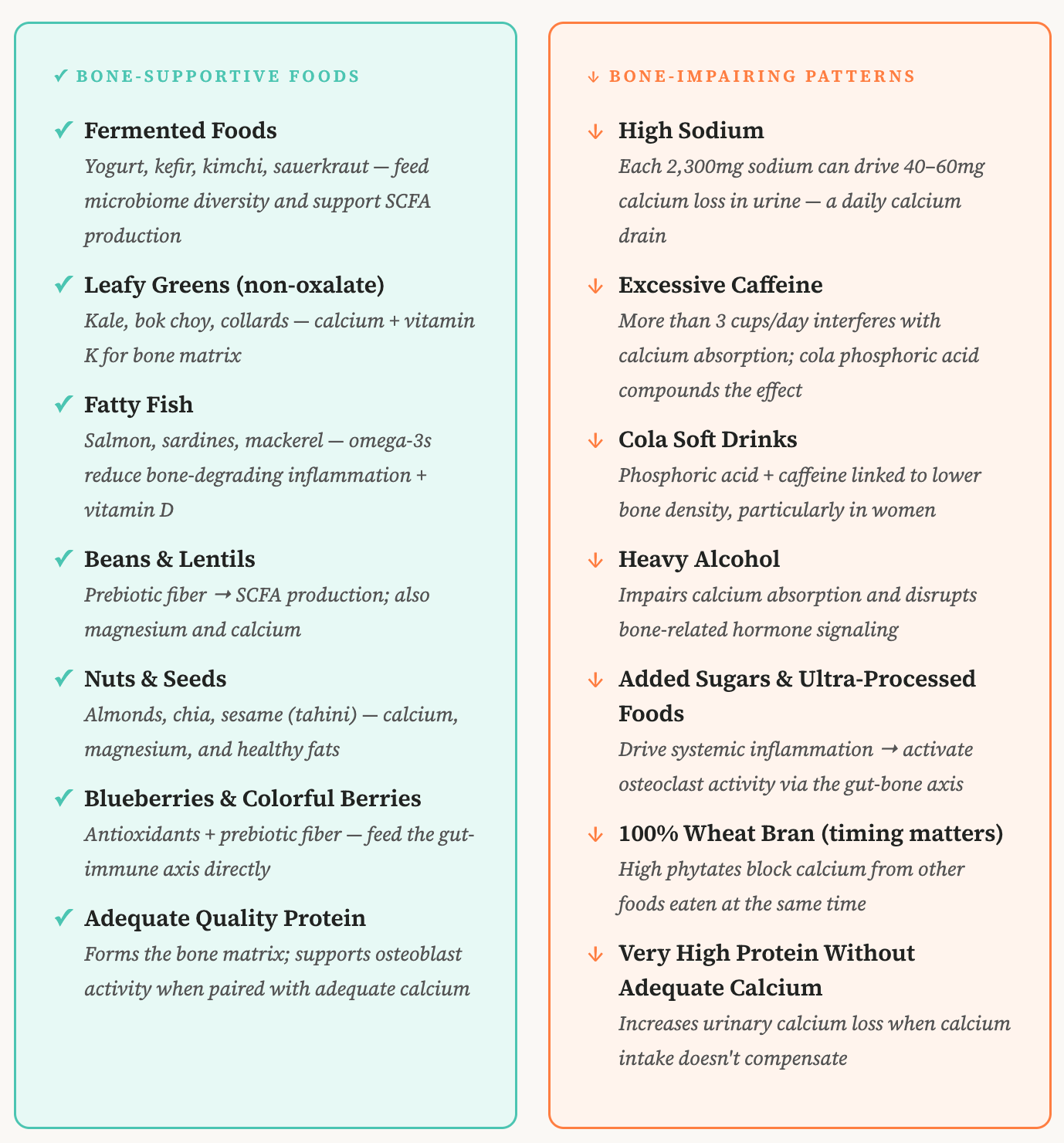
A word on spinach and oxalates: this is one of the most common nutrition myths I encounter. Spinach is a poor calcium source because oxalates bind to its calcium — but it’s still a deeply nutritious food. The issue is eating it as your primary calcium strategy. Vary your greens and calcium sources and you’ll see weight health wins.10
The Weight Health Bottom Line
Bone health isn’t a separate conversation from weight health — it’s embedded in it. Inflammation drives both metabolic dysfunction and bone loss. Gut dysbiosis (fancy term for when the microbiome is imbalanced in a negative manner) drives poor nutrient absorption, reduced SCFA production, and challenges weight-health hormone activity which all matter for bone remodeling. The total nutrition choices and gut health that undermine your weight health are the same ones that degrade your skeleton.
What’s newsworthy here is that we now have a clinically validated, gut-targeted intervention in Bōndia that works through the actual mechanism driving bone loss in so many women: the inflammatory gut-bone-immune axis. An 85% reduction in femoral neck bone loss in a quality research study is not a small finding. It is the kind of finding that should shift how we think about early intervention for osteopenia.
Better nutrition, a trained digestive muscle, and the right targeted support, in my opinion that’s not the future of bone care, it’s the now! Not waiting for osteoporosis to show up on a DEXA scan. Not accepting that bone drugs with serious side effect profiles are the only option.
Feed your gut. Train your digestion. Protect your bones. Shot or not — this is weight health.
If you are interested in trying it, we have an affiliate code for you to save 20% off - use BETTERNUTRITIONPROGRAM at checkout here
Better not perfect,
Ashley Koff, RD
Founder, The Better Nutrition Program · Author, Your Best Shot
Research References
Feng B, Lu J, Han Y, et al. The role of short-chain fatty acids in the regulation of osteoporosis: new perspectives from gut microbiota to bone health. Medicine (Baltimore). 2024;103(34):e39471. doi:10.1097/MD.0000000000039471
Dietary fiber derived short-chain fatty acids as a critical driver of the gut–bone axis in bone health. PMC/ScienceDirect. 2025. PMC12391820
Sōlaria Biō. Bondia clinical trial results: 85% reduction in femoral neck bone loss. Osteoporosis International, 2025. Announced October 20, 2025.
Sōlaria Biō. Bōndia ingredient and formulation information. solaria.bio
Sōlaria Biō. Microbe blend gut delivery study. Beneficial Microbes, February 2026. PRNewswire
Sōlaria Biō. Mechanistic research: gut barrier, inflammation, and bone resorption. December 2025. Press release
Hospital for Special Surgery. Bisphosphonate side effects and risks. hss.edu
StatPearls. Bisphosphonate Toxicity. Updated December 2025. NIH
Fan et al. A promising fusion: Traditional Chinese medicine and probiotics in the quest to overcome osteoporosis. FASEB Journal. 2025. doi:10.1096/fj.202403209R
Bone Health & Osteoporosis Foundation. Osteoporosis Diet & Nutrition. bonehealthandosteoporosis.org